
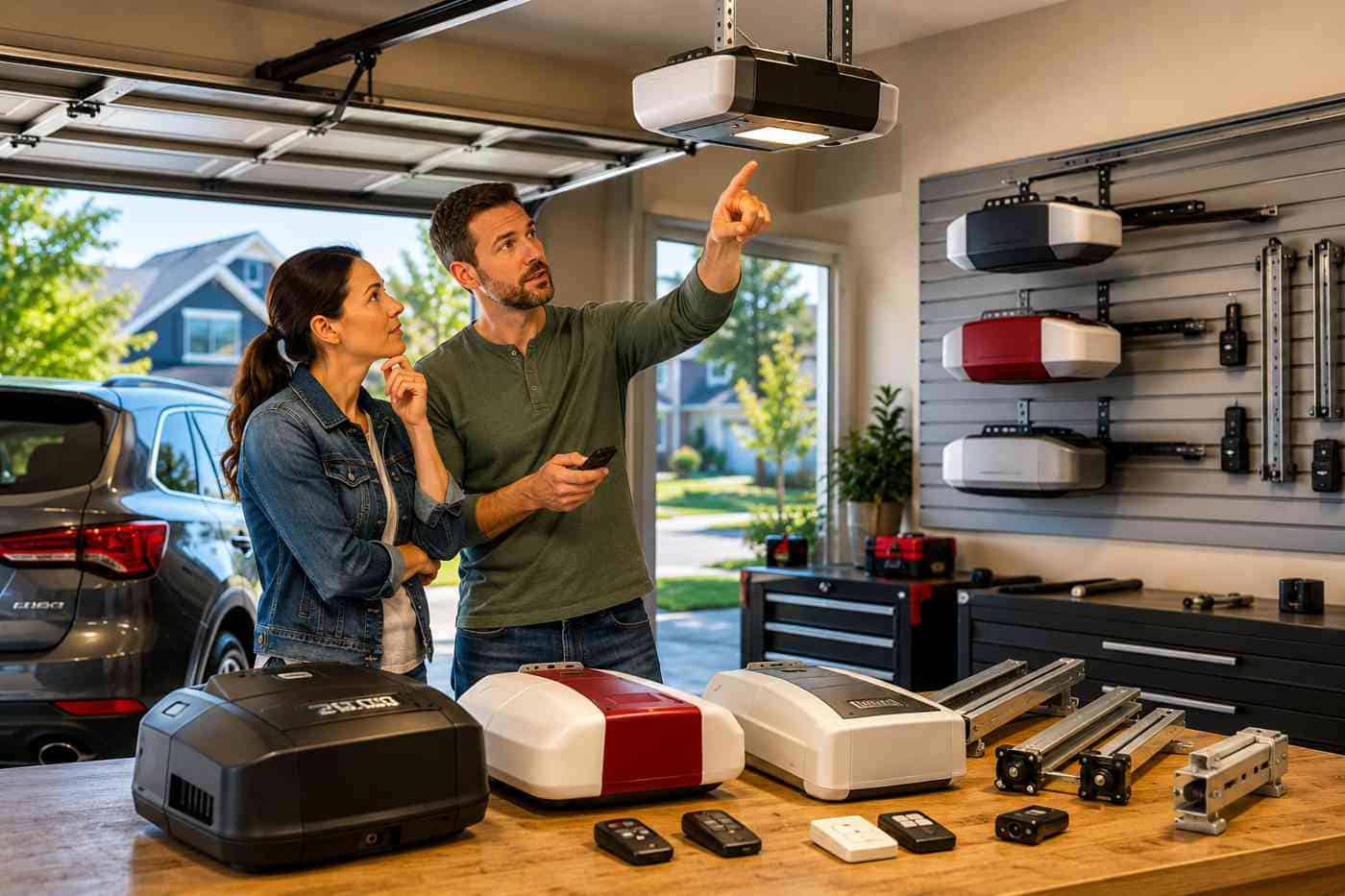
Choosing the right garage door opener depends on several factors, notably your security needs, the weight and size of the door, and your budget. There are a variety of garage door openers to choose from. You want to choose a trusted brand that comes with a manufacturer’s warranty. In this comprehensive guide, we’ll explore key features and options of garage door openers to take into consideration for your specific needs. This will help you to make an informed decision.
Table of Contents
ToggleUnderstanding Your Garage Door Requirements
One of the first things you will need to do is determine the size and weight of the door that the opener will be lifting. You also need to take into consideration whether it is a single or a double garage door. These are all important in figuring out the correct horsepower of the motor that operates the garage door opener.
Assessing Door Size and Weight
The size and weight of a garage door are likely the most important considerations when determining which garage door opener you will select. Door weights typically range from 150 to 800 pounds. Garage doors range in size and configuration from standard single doors to double and triple doors. Sizes available are from 8 feet wide by 7 feet tall up to 24 feet wide by 8 feet tall. According to the International Residential Code, a garage door has to be labeled by the manufacturer with test information and mode/series number. This label usually displays the weight and size. If not, call the manufacturer.
Single vs. Double Garage Doors
The most popular garage doors are single and double. Single doors are between 7 and 8 feet wide and 7 and 8 feet tall. Single doors are perfect for a one-car garage or for a larger two-car garage that has space for two single doors. You will need a garage door opener for each of the single doors.
Double doors are commonly 16 feet wide and 7 to 8 feet high. Double doors are perfect for two-car garages that are tight on space. This type of door can be operated by a single garage door opener that has enough horsepower for its weight.
Types of Garage Door Openers
There are five types of garage door openers, each with different operating mechanisms or control options. These include:
-
- Chain-Drive Openers
-
- Belt-Drive Openers
-
- Screw-Drive Openers
-
- Wall-Mount (Jackshaft) Openers
-
- Smart Openers
Chain-Drive Openers
Chain-drive openers are the most common. They use a chain to lift and lower the garage door. Chain-operated openers are affordable and durable, making them a good return on investment. They are best for heavier doors. Chains do require lubrication to ensure smooth operation.
Belt-Drive Openers
If you want a quieter opener, belt-drive is a good option. This garage door opener is ideal for attached garages. The lifting component is a rubber belt. Belt-drives are available at a higher price point than chain-drive openers.
Screw-Drive Openers
Screw-drive openers are just what they sound like. The operating mechanism is a threaded steel rod that rotates like a screw to raise and lower the door. Screw-drives have fewer moving parts, making them very low-maintenance. They are also powerful and a good choice for heavier doors.
Wall-Mount (Jackshaft) Openers
Wall-mounted or jackshaft openers are placed on the wall to one side of the garage door, as described by Garage Door Pedia. This frees up ceiling space for taller cars or ones with rooftop cargo racks. These openers operate via a torsion spring to lift the door. If overhead space is at a premium, a jackshaft opener is a good choice.
Smart Openers
You have the ability to install a smart garage door opener that is Wi-Fi enabled. The opener can be operated remotely using your smartphone, voice-activated assistant, or tablet. When you link the opener to your smartphone app, you can get notifications when the door is open. You can also open the door when you aren’t home to allow someone to enter the garage. The benefits of a smart opener are better security and ease of operation.
Key Features to Compare
While all garage door openers perform the same job of lifting and lowering the door, there are some key features to look for that meet your specific needs.
Horsepower Options
Garage door openers are available with motors as low as 1/3 horsepower and as high as 1.5 horsepower. A good guide to use for choosing the correct horsepower motor for the weight of your door is:
-
- 1/3 HP: up to 150 pounds
-
- 1/2 HP: up to 350 pounds
-
- 3/4 HP: up to 650 pounds
-
- 1 HP: up to 750 pounds
-
- 1.5 HP: over 750 pounds
Noise Levels
Depending on the opener you choose, it can be noisy when operating. Chain-drive openers are the noisiest, while belt-drive and direct-drive openers are quieter. The noisy openers are best suited for detached garages. Less noisy openers are well-suited for attached garages.
Safety and Security Features
Safety and security need to be taken into consideration when shopping for a garage door opener. An access code is needed for the operation of many garage door openers. Rolling code technology changes the access code after each use so that an intruder can’t grab the code. Some openers come with surveillance cameras for added security. Built-in security lights add another layer of protection when they automatically turn on using a motion sensor.
Battery Backup and Power Outage Operation
In the event of a power outage, a battery backup ensures the garage door opener will operate. The battery can be built into the opener, or it can be a separate unit. Integrated battery backups offer a seamless solution to power outages.
Smart Home and Automation Compatibility
Smart garage door openers can be linked to your home’s automation system via your Wi-Fi network. Doing this offers remote access, receipt of alerts and notifications, and voice control. This feature is especially useful when you are away from home and need to operate the opener from a remote location for deliveries.
Budget and Brand Considerations
When budgeting for a new garage door opener, there are a few things to take into consideration. These include opener type, warranty, longevity, and brand reputation.
Price Ranges by Opener Type
Openers range in price depending on the type. Depending on the brand, here is a comparison of price ranges:
-
- Chain-drive: $150 to $350
-
- Belt-drive $200 to $500
-
- Screw-drive: $250 to $400
-
- Direct-drive: $300 to $700
-
- Wall-mounted: $400 to $800
Warranty and Longevity
Reputable garage door opener brands do come with manufacturer’s warranties. A basic or limited warranty is for 1 to 5 years, covering product defects and parts. Sometimes, you can opt to buy an extended warranty that covers repairs and replacement beyond the manufacturer’s standard limited warranty. A labor warranty is something you get from the installer, and it is typically for 1 year.
You can expect a good quality garage door opener to last beyond the warranty, generally 10 to 15 years. Longevity depends on proper maintenance, frequency of use, and quality of the brand chosen.
Reputable Brands Worth Considering
There are several garage door opener brands to choose from. Here are some of the more popular brands with good reputations according to Popular Mechanics.
Chamberlain is one of the leading brands of garage door openers on the market. This brand has durable and reliable chain-drive and belt-drive openers. These come with smart technology and battery backups.
Craftsman offers budget-friendly chain-drive openers and 3/4 HP belt-drive openers. These openers come with wireless keypads and an energy-saving standby mode to reduce electricity use.
Genie is a household name for residential garage door openers. Their chain-drive opener is a good value for its performance. The belt-drive opener boasts quiet operation. Safe-T-Beam technology provides an infrared beam that detects an object in the path of a door to prevent closing.
LiftMaster is likely the most familiar brand in the industry. It is known for its solid construction and durability. Popular is the belt-drive opener with integrated Wi-Fi and motion-sensing lights. The space-saving jackshaft opener comes with battery backup.
Installation and Maintenance
Proper installation and periodic maintenance of a garage door opener is necessary for longevity and performance.
DIY vs. Professional Installation
If you are handy with tools and electrical wiring, you certainly can install an opener yourself. However, you won’t benefit from a warranty for labor from a professional. If you are installing a jackshift opener, it is recommended that you use a skilled professional because of the complexity and precision needed.
Routine Maintenance Requirements
All types of garage door openers require some periodic maintenance. Chains, rollers, and hinges need to be lubricated. Sometimes an opener needs rebalancing to ensure the door is opening evenly on both sides. It is recommended that any safety features be tested on a regular basis.
When to Seek Expert Help
Sometimes it makes sense to seek help from an expert for more complex installations. You may also need technical help when integrating the opener with your smart home system. Depending on your skillset, it is also a good idea to have your garage door opener checked and maintained by someone who does it for a living.
Frequently Asked Questions
Selecting the right garage door opener isn’t always straightforward for many people. Here are some frequently asked questions and answers that may help clarify the process.
Should I get a 1/2 HP or 3/4 HP garage door opener?
If your garage door weighs between 150 and 350 pounds, you can choose a 1/2 HP motor. If the door is heavier, at 350 to 650 pounds, you will need a 3/4 HP motor.
How many HP do I need for a 16 ft garage door?
While a 1/2 HP garage door opener motor might be able to handle a lightweight aluminum or fiberglass 16-foot-wide door, you are better off opting for a 3/4 HP motor to reduce wear on the opener over time. A heavier solid wood double door will require at least a 3/4 HP opener.
What is the best type of opener for a heavy door?
Your best options for heavier doors are a chain-drive or screw-drive garage door opener. You might also consider a direct-drive opener for its fewer moving parts.
How long do garage door openers last?
The lifespan of a garage door opener depends on several factors, such as brand quality, usage, and maintenance. Typically, you will get 10 to 15 years of use out of your garage door opener.


